Solution · Construction

Remove construction moisture –
Drying new buildings & winter construction

Every new building brings tons of water with it – from concrete, screed, plaster, and mortar. As long as this construction moisture remains in the structure, there is a risk of mold, construction delays, and frost damage in winter. DÖLCO removes moisture from the building in a predictable way: using robust mobile condensation dryers, adsorption technology, and construction heating.

Consultation Expert advice: +49 7664 50559-0

The problem

What construction moisture causes

An average single-family home contains several thousand liters of water after the structural shell is completed, which must be removed. If construction moisture is not removed actively and in a controlled manner, it quickly becomes expensive.

Mold & structural damage
Damp walls, screeds, and trapped residual moisture are the ideal breeding ground for mold – often only noticed after moving in, then as a costly defect.
Construction delays & scheduling risks
Painters, floor layers, and drywallers can only continue working once the substrate is ready for covering. A construction that is too wet blocks entire trades and disrupts the construction schedule.
Frost damage in winter construction
Below freezing, the water in the still-damp concrete and mortar expands and bursts the structure. Fresh screed and fresh masonry must be kept above the frost threshold.
Screed not ready for covering
If parquet, vinyl, or tiles are laid on screed that is too damp, the residual moisture migrates into the covering: cupping, detachment, and discoloration – damages that fall back on the installer.

The solution

Drying as a controllable process

DÖLCO does not leave new building drying to chance, but makes it predictable – with equipment that stands up to the construction site and the right technology for every temperature.
Remove construction moisture –
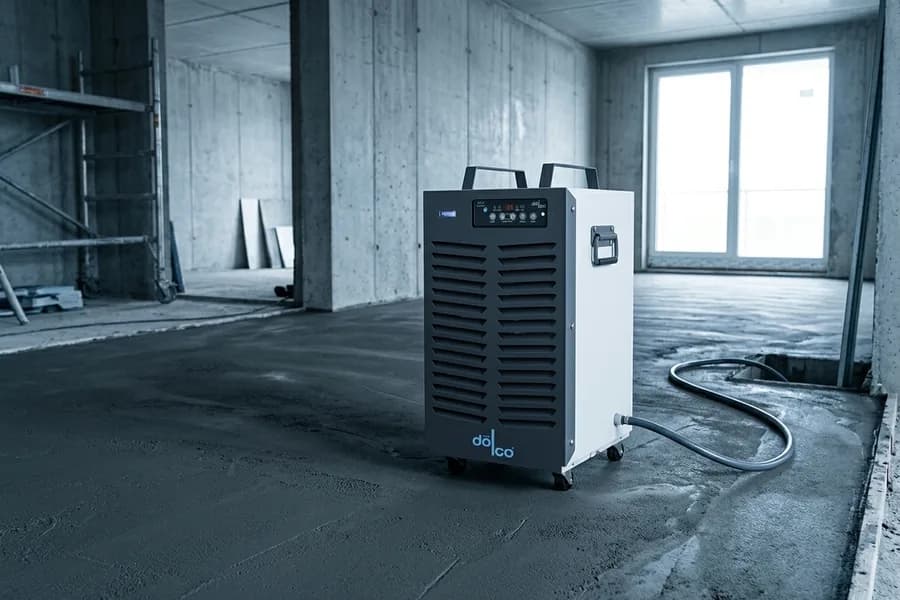
Mobile condensation dryers
Robust LE units reliably extract construction moisture from the room air and structure – easy to transport from floor to floor.
Construction heating for winter
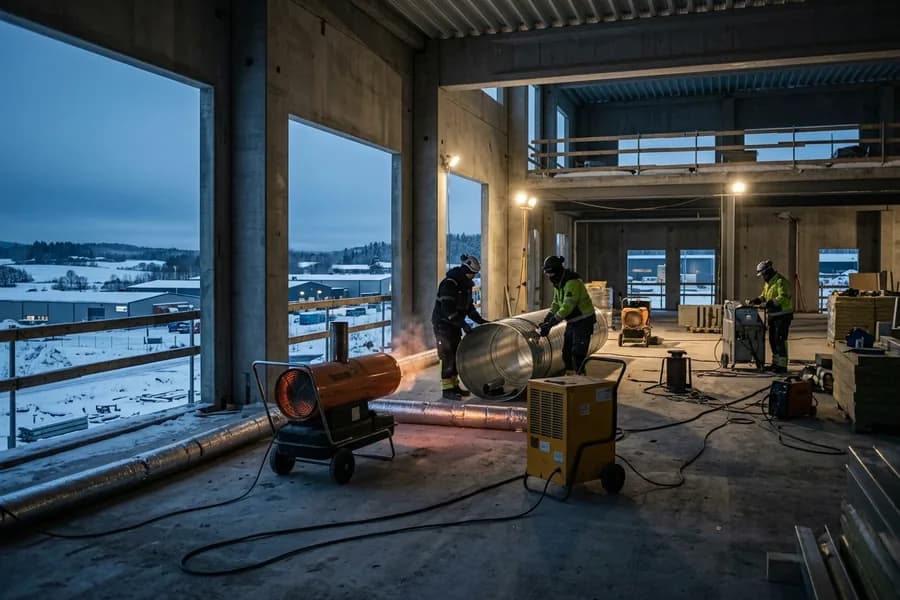
Electric, gas, and oil heaters keep the construction site above the freezing point and accelerate the drying process through higher air temperatures.
Adsorption for cold conditions
Where condensation dryers reach their limits in the cold, temperature-independent adsorption technology continues to dehumidify – ideal in winter and in unheated structural shells.
System instead of individual units
Heating, air circulation, and dehumidification work together – creating a predictable, documentable drying process instead of trial-and-error.

Expertise

How new building drying works

Concrete, cement mortar, plaster, and screed are mixed with significantly more water than the binders chemically require. This excess water must be removed from the structure through evaporation – new building moisture is the actual drying problem. Condensation dryers direct the damp room air over a cold evaporator where the water condenses; this is energy-efficient but loses performance at low temperatures. Adsorption dryers bind moisture to a hygroscopic material and work independently of temperature – which is why they are the first choice in cold structural shells.

Before a floor covering is laid, the screed must be ready for covering – the decisive factor is the residual moisture in the cross-section, measured using the CM method. Common standard values: cement screed around 2.0 CM-% (unheated) or 1.8 CM-% (heated), calcium sulfate screed 0.5 or 0.3 CM-%. Under damp conditions, these values can only be achieved through active dehumidification – passive ventilation is usually not enough in new buildings.

Below approximately +5 °C, setting and drying reactions slow down significantly; below 0 °C, there is a risk of frost damage. In winter, the following combination applies: construction heating keeps the structure above the frost threshold, and adsorption dryers remove the moisture even in the cold. To prevent a condensation dryer from icing up, hot gas defrosting is important. Rule of thumb: drying requires warm, moving, and controlled dehumidified air – if one component is missing, the process comes to a standstill.
How new building drying works

Products

The right DÖLCO equipment

Condensation dryers for the main load, adsorption for the cold, construction heating against frost – working in tandem depending on the season and construction phase.

Condensation dryer LE-3600
Light, robust, ~33 l/24 h. The workhorse of screed and new building drying – available in variants with condensate pump (KP) and hose connection (S).
LE-25000 mini
Up to 750 m³/h, integrated hot gas defrosting, 14-l container – for larger rooms and continuous operation even at lower temperatures.
DÖLCO construction heating
Electric, gas, and oil heaters keep the construction site above the frost threshold in winter and accelerate drying.
Adsorption dryers
Temperature-independent dehumidification in cold structural shells and winter construction, where condensation dryers reach their limits.
View all construction dryers

FAQ

Frequently asked questions

How long does it take to dry a new building?
This depends on the component thickness, screed type, temperature, and air movement. Cement screed often takes several weeks to be ready for covering. With active dehumidification and heating, the duration can be significantly shortened and made predictable.
Condensation dryer or adsorption dryer?
At normal temperatures, the condensation dryer is energy-efficient and the method of choice. At low temperatures – typical in winter construction – the adsorption dryer continues to work independently of temperature and is then superior.
When is a screed ready for covering?
When the residual moisture in the cross-section falls below the CM limit values: cement screed approx. 2.0 CM-% (unheated) or 1.8 (heated), calcium sulfate screed 0.5 or 0.3. The CM measurement is the decisive factor, not the impression on the surface.
Is it possible to dry in winter at all?
Yes – with the right combination. Construction heating keeps the structure above the frost threshold, and adsorption dryers or condensation dryers with hot gas defrosting remove the moisture even in the cold.
Is regular ventilation enough for drying?
In new buildings, usually not. In damp or cold weather, the outside air absorbs hardly any moisture – without active dehumidification, the drying process drags on and the risk of mold remains.

Consultation

Drying a new building correctly?

Our expert consultants will recommend the right combination of equipment for your project and construction phase – free of charge and without obligation.

📞 +49 7664 / 50559-0✉ info@doelco.de