Solution · Water Damage
Locate first,
then dry
Water damage leaves no room for delays: where moisture remains undetected in screed, insulation layers, and walls, mold and consequential damage threaten within days. DÖLCO supports the remediation process from the initial assessment to documented drying – measuring, locating, drying, seamlessly documented and ready for action around the clock.
The Problem
The damage is deeper than it looks
Water damage is rarely where it becomes visible. What starts as a damp spot has often long since penetrated the load-bearing components. Anyone who only dries what they see is treating the symptom – not the damage.
The Solution
Remediation starts with the assessment
DÖLCO does not start with the dryer, but with the assessment. Only when the source and extent of the damage are precisely known does effective drying begin – targeted, material-friendly, and verifiable.
Expertise
Why location comes before drying
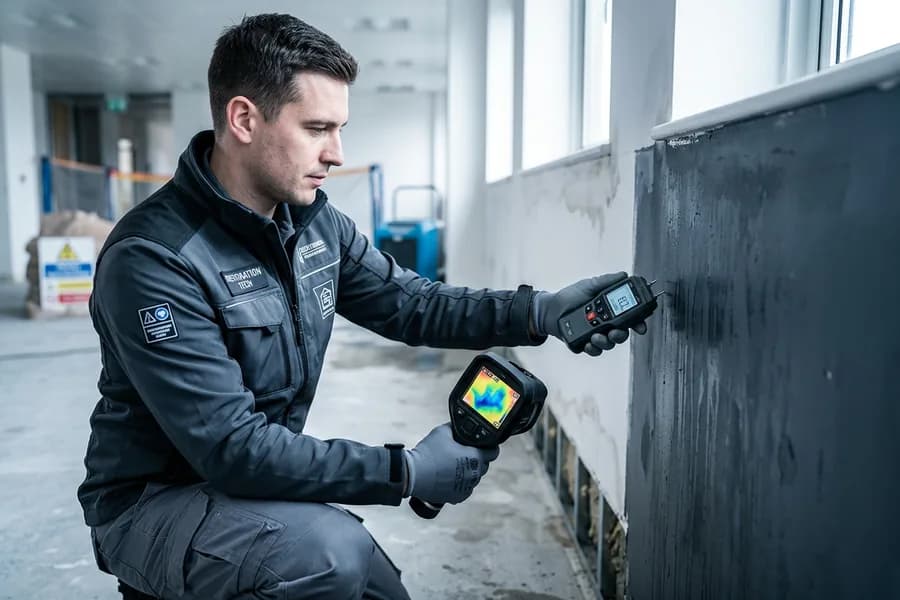
Water damage has two dimensions: the source (the leak) and the extent (the damp building components). If you start drying without closing the leak, you are drying against an open tap. And without the exact damage boundary, you either under-dimension – leaving residual moisture – or break up unnecessarily large areas. That is why non-destructive diagnostics come first: moisture measurement maps the dampness, thermography makes temperature differences visible, and electro-acoustics and tracer gas localize the leak precisely.
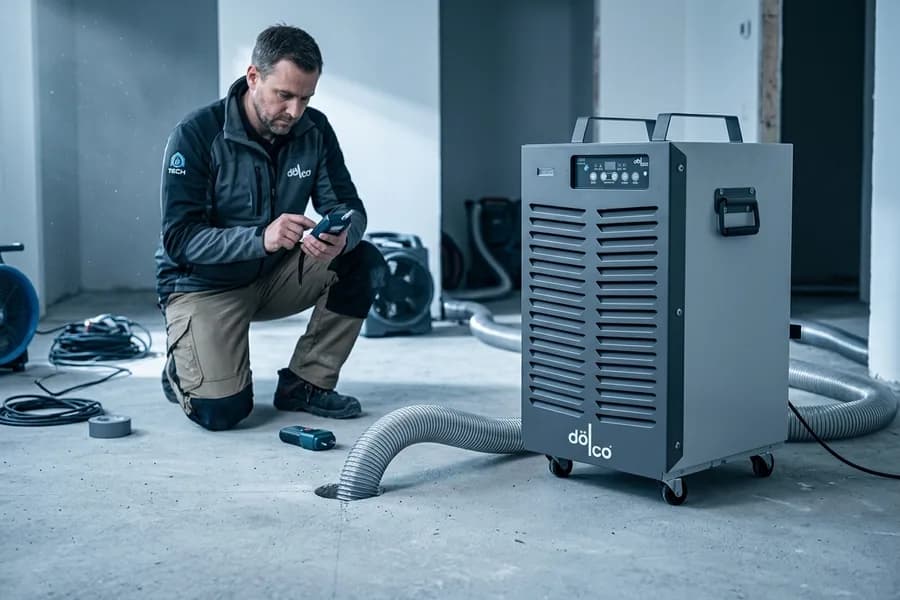
Two principles are used for drying: condensation drying draws moist air over a cooled register where the water condenses – efficient in the normal temperature range. Adsorption drying binds moisture to a desiccant and works even at low temperatures. For trapped moisture, insulation layer and cavity drying is used: side channel blowers drive air through the insulation layer under the screed via slot nozzles – without destroying the floor structure. Infrared heating panels accelerate the drying of damp walls.
Drying is not finished when the surface looks dry, but when the material moisture has reached the component-specific target value again. This is exactly where remote monitoring comes in: IoT data loggers provide a continuous curve of the drying process instead of spot checks. This prevents premature shutdown (mold risk) as well as unnecessarily long equipment operation – and provides the insurer with seamless proof.
Products
The entire process chain
DÖLCO manufactures everything from the measuring probe to the drying tower itself. For water damage remediation, these devices work in tandem:
FAQ
Frequently asked questions
Why should leak detection be carried out before drying?
Does the screed have to be broken up?
How long does the drying take?
How is the success documented for the insurance company?
How quickly must action be taken?
Emergency & Consultation
Water damage? Act now.
Our team locates, dries, and documents – available around the clock. Call us or request a callback.